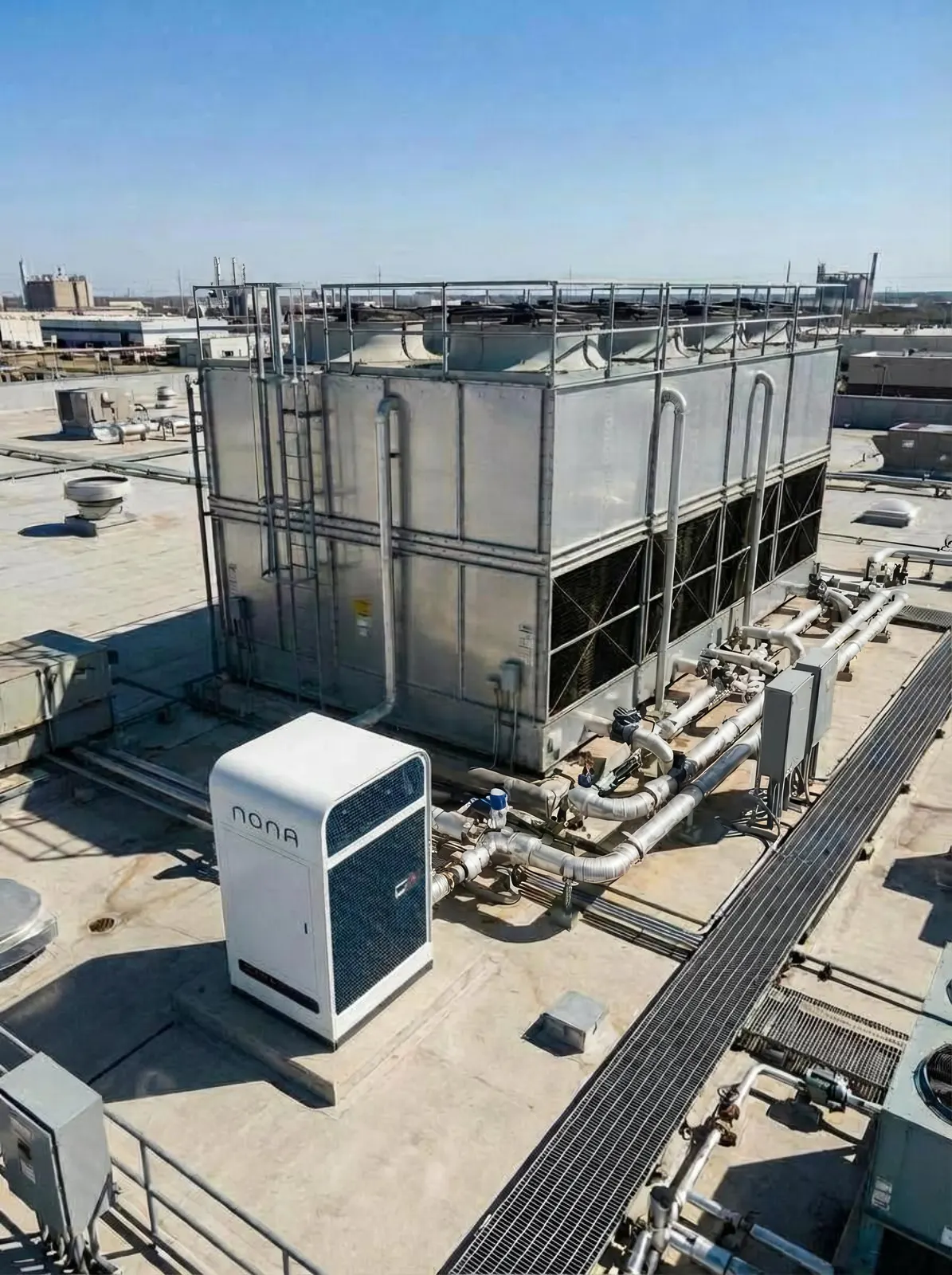
Recover cooling water without replacing your tower.
A cooling tower drains water to keep minerals from building up. Operators call it blowdown. RECOVER treats that water and returns it to the tower. How much new water you can avoid depends on your tower's flow and water chemistry.
Which cooling system do you use?
RECOVER treats water drained by a cooling tower, not the water that evaporates. A hybrid system has water to treat only while its tower runs. A fully dry system has no cooling tower water for RECOVER to reuse.
| Cooling design | Water RECOVER can treat | Does RECOVER fit? |
|---|---|---|
| Cooling tower (wet) | Water drained from the tower | RECOVER can treat this water for reuse if its flow and chemistry meet the cooling system's requirements. |
| Hybrid wet and dry cooling | Water drained while the tower runs | Estimate how many hours the wet side runs and how much water it drains. Fully dry hours do not provide water for RECOVER to treat. |
| Fully dry cooling | No tower water to treat | RECOVER's cooling tower application does not fit. Ask how the dry option changes cooling electricity used across the year and during the hottest hours. The answer depends on equipment and climate. |
If you go dry, how much electricity will cooling need?
Ask your engineer to compare a wet or hybrid design with the dry option at the same server load and local weather. Include fans, pumps, chillers, and controls. The answer may change sharply on hot days.
Across the year: How many more kilowatt-hours (kWh) would dry cooling use? Subtract the wet or hybrid cooling total from the dry cooling total.
On the hottest days: How much higher would peak power demand be, in kilowatts (kW)? Check whether the site has enough electrical capacity and what peak charges would cost.
Compare those electricity changes with new water brought in and water sent to drain. The change cannot be stated for every facility without a design and weather model.
When comparing cooling choices, look at both the new water a site needs and the electricity its cooling equipment uses. A dry option cannot be judged by its water use alone.
Sources: EPRI on cooling tradeoffs, DOE on hybrid wet and dry operation, and The Green Grid on site and source water boundaries.
What changes for your water goals?
RECOVER treats water a cooling tower would send to drain. The amount you can reuse depends on how your tower operates.
Compare water and electricity in the same scenarioWhat if our site uses wet and dry cooling?
RECOVER can treat water drained by a cooling tower while the wet side runs. When the system is fully dry, there is no tower water to recover. Your hours in each mode determine the opportunity.
How can RECOVER help our water goals?
Reusing treated tower water can reduce the new water brought in and the liquid sent to drain. The 90% design target applies to the drained water RECOVER treats, not total site water. Measure both site flows before claiming savings.
What can we say in a water report?
Track new water brought in and water discharged before and after treatment. Keep water lost to evaporation separate. Check your reporting rules before calling recovered water a reduction in site consumption.
Beyond RECOVER
Have a different water stream?
RECOVER treats cooling tower water. The ICP technology inside it can also be assessed for other industrial water streams. Each needs a separate review; RECOVER's 90% target does not carry over.
Discuss another water applicationWater polishing
Treat water to meet a specific quality need. Check the incoming water and the required result.
RO brine treatment
Evaluate the concentrated waste stream from a reverse osmosis system. Check its chemistry and disposal route.
Industrial water reuse
Assess whether used process water can meet the quality needed for another use on site.
Source: Nona Ion Concentration Polarization Module technical sheet, September 2026. These are example applications, not performance guarantees.
Find out what your site could reuse.
Start with the calculator. For a number you can put in a water plan, our team needs to know how much your tower drains, how often it runs, and what is in the water.