Data center water systems
Four water systems at a data center, and the one you can buy today
RECOVER recovers cooling tower water on site and cuts fresh water used for cooling by up to 50%. We're also exploring brackish feedwater, fill and flush water, and cooling water at on-site power plants.
Short answer
A data center site has four places Nona's water systems could fit: the cooling tower, the source water feeding it, the new closed loops that liquid cooling adds, and any on-site power plant. RECOVER handles the cooling tower and is the product we sell today. We're exploring the other three.
Start with cooling tower water recovery, or read the cooling tower blowdown recovery guide.
System 1: available today
Cooling tower water recovery with RECOVER
RECOVER is an MIT-patented retrofit[6] that works alongside an existing evaporative tower. It treats the cooling water the tower would otherwise send to the drain and returns it to the loop.
Up to
50%
Less fresh water used for cooling.
90%
Of cooling tower blowdown recovered in on-site testing.
Why towers drain water
When water evaporates from a tower, dissolved solids stay behind. If they build up too far they cause scale and corrosion, so the tower discharges some of its water as blowdown[1]. The more cycles of concentration a tower runs, the less it drains: at 2 cycles about half the water it takes in leaves as blowdown, at 5 cycles about a fifth.
Installed at a data center
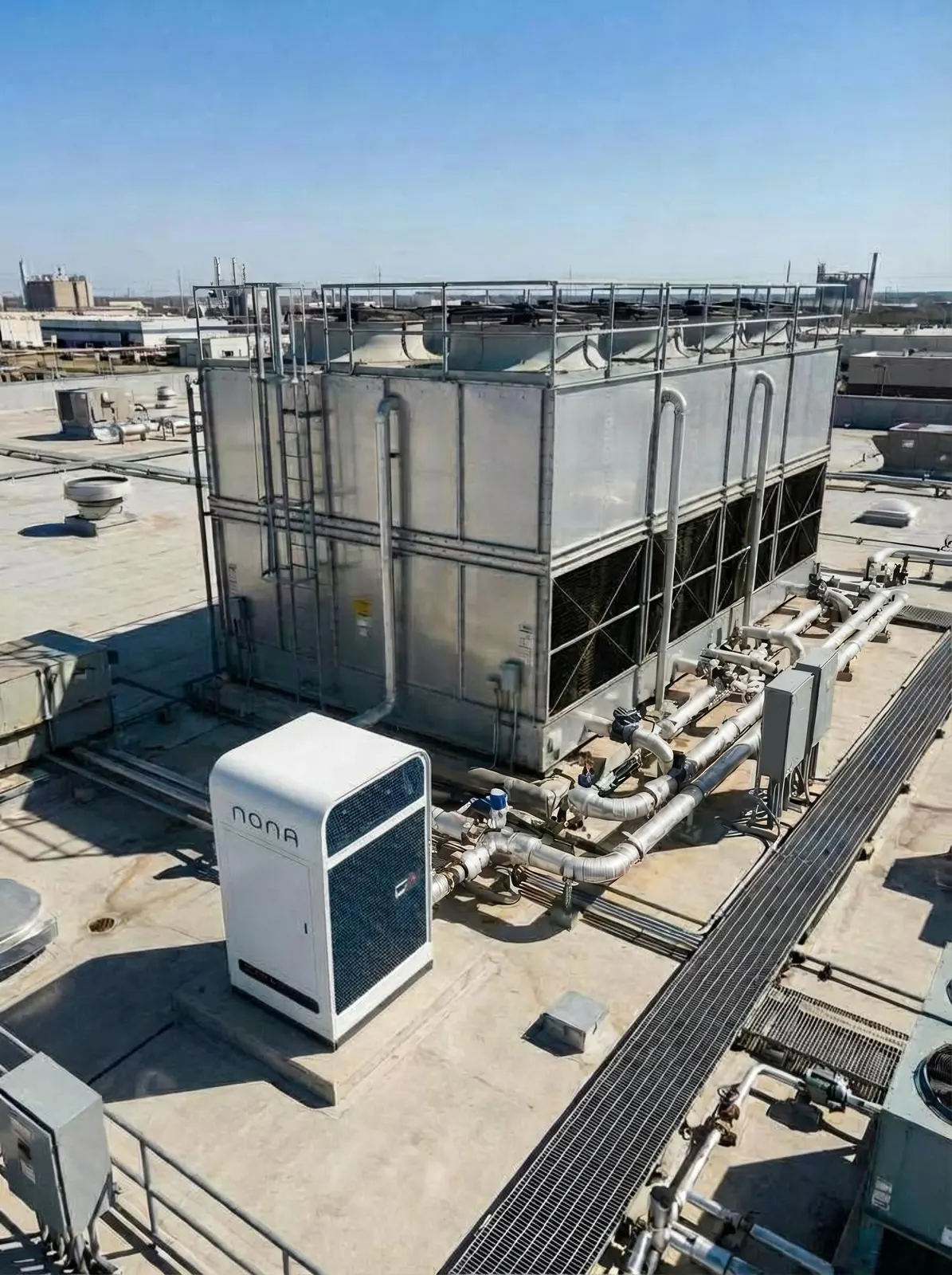
RECOVER is installed on the cooling tower of a data center building in Ohio. Results at any site depend on its water chemistry, flow and operating hours.
Running liquid cooling?
RECOVER treats the tower water, so the cooling method inside the hall does not change it. A liquid cooled hall passes its heat through a heat exchanger to that separate loop, and the loop rejects it through the cooling tower. More heat on that loop means more evaporation and more blowdown at the tower. RECOVER treats the facility water. The closed technology loop on the IT side is a different application, covered under system 3.
Three systems we're exploring
These are not Nona products today, so this page gives no specification, schedule or result for them.
System 2: exploring
Brackish feedwater
We're exploring treatment that would let a site use local brackish or poor quality water as tower makeup. USGS defines brackish groundwater as 1,000 to 10,000 mg/L of dissolved solids, against 35,000 mg/L for seawater[2]. Which sources would fit is part of what we're exploring.
System 3: exploring
Fill and flush water
We're exploring recycling the water used to fill and flush new closed loops and liquid cooling systems. Open Compute Project guidance has loops flushed with water meeting set quality limits, which reverse osmosis permeate or deionized water will typically meet, then typically filled with propylene glycol heat transfer fluid[3]. Where recycling could fit in that process is part of what we're exploring.
System 4: exploring
On-site power plant cooling water
We're exploring cooling water recovery at on-site power plants serving a data center, whether gas, renewable or nuclear. Steam turbine plants reject heat too: more than 61% of US thermoelectric generating capacity uses recirculating cooling systems[4], which lose water to evaporation, blowdown, drift and leakage[5].
Data center water systems: common questions
Short answers on what is available today and what we're still exploring.
What are the four water systems at a data center?
Cooling tower water recovery, brackish feedwater treatment, recycling the water used to fill and flush new closed loops and liquid cooling systems, and cooling water recovery at on-site power plants. RECOVER does the first and is available today. We are exploring the other three.
Which of the four can I buy today?
Cooling tower water recovery. RECOVER is the only one of the four that is a Nona product.
Does liquid cooling change whether RECOVER fits?
Not where the heat still goes to an evaporative cooling tower. RECOVER treats the tower water, so the cooling method inside the hall does not change it. It does not treat the closed technology loop on the IT side.
Is that the same as fill and flush water?
No. RECOVER treats the tower water while the site runs. Fill and flush is the water used to prepare a new closed loop before it enters service, and we are still exploring it.
Can Nona treat brackish water as makeup for my tower?
We are exploring it. We do not offer a product for it today, and whether a given source would fit depends on its chemistry.
Sources & references
Numbered facts on this page trace to the public sources below. Nona's performance figures come from Nona's own on-site testing, and site results depend on flow, chemistry and operating hours.
- WaterSense at Work, Section 6.3: Cooling Towers
US EPA (October 2012). Evaporation, dissolved solids, scale and corrosion, blowdown, and cycles of concentration.
- Brackish groundwater fact sheet 2017-3054
US Geological Survey (July 2017). Dissolved solids ranges for brackish water and seawater.
- Guidelines for Pre-Commission Preparation of Technology Cooling System (TCS) Row Manifolds in Liquid Cooled Data Centers
Open Compute Project (January 2025). Flushing and filling steps before a loop enters service.
- Some U.S. electricity generating plants use dry cooling
US Energy Information Administration (August 29, 2018). Share of thermoelectric capacity on recirculating cooling.
- Thermoelectric Power Water Use
US Geological Survey. Water lost from recirculating systems to evaporation, blowdown, drift and leakage.
- Return Flow System for Ion Concentration Polarization (ICP) Desalination
MIT Technology Licensing Office, US Patent 11,780,754.
See what RECOVER could save at your tower.
Use the calculator for a first estimate, then confirm flow, chemistry and operating hours with our technical team.