Cooling water recovery guide
Cooling tower blowdown recovery, explained.
Cooling tower blowdown recovery treats the concentrated water a tower would normally discharge and returns usable water to the cooling loop. The right approach depends on your water balance, chemistry, discharge limits, and recovery goals.
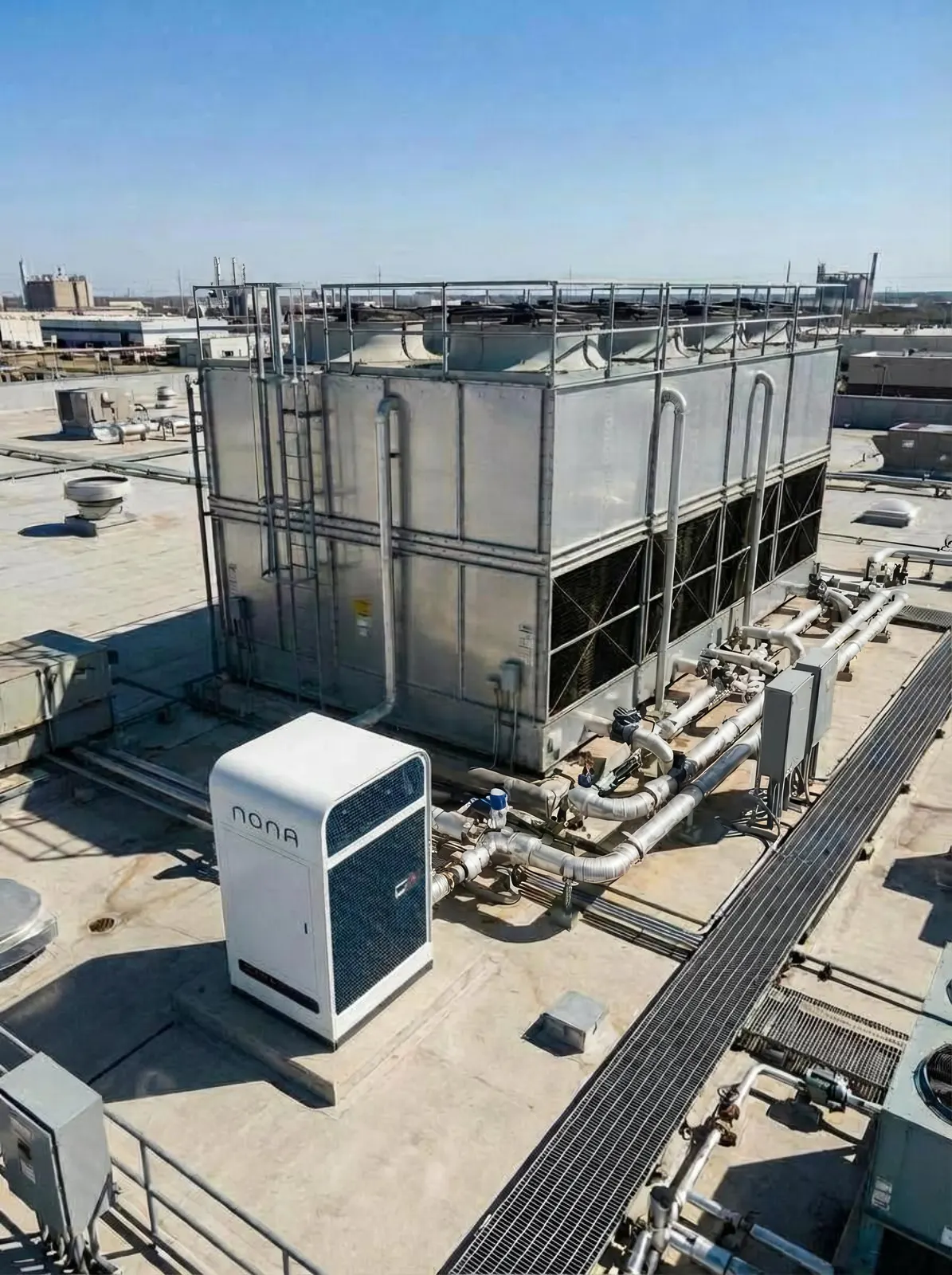
The operating problem
Why cooling towers need blowdown
Cooling towers reject heat by evaporating a portion of recirculating water. The water leaves, but dissolved solids such as calcium, magnesium, chloride, and silica remain. Their concentration rises with every cycle.
Blowdown, also called bleed-off, removes part of that concentrated water and replaces it with fresh makeup water. Without enough blowdown, scale and corrosion can damage the tower and connected equipment. With too much, a facility sends usable water and purchased treatment chemicals down the drain.
The U.S. Department of Energy identifies careful blowdown control as one of the most significant cooling tower water-conservation opportunities. Read the DOE guidance.
Higher cycles usually mean less blowdown and less makeup water, but only until site chemistry reaches its operating limit. DOE notes that many systems run at two to four cycles, while six or more may be possible. EPA estimates that moving from three to six can reduce makeup water by 20% and blowdown by 50%, subject to site-specific chemistry. Review the EPA calculation.
Operator sequence
A five-step blowdown recovery process
Start with the tower you have. Add treatment only after the water balance and chemistry show where recovery creates value.
- 01
Establish the water balance
Measure makeup, blowdown, conductivity, evaporation, drift, and known leaks. A recovery model is only useful when the current water balance is credible.
- 02
Optimize the tower first
Check conductivity control, overflow, drift, treatment dosing, and current cycles of concentration. Some sites can reduce avoidable losses before adding recovery equipment.
- 03
Characterize the blowdown
Test hardness, silica, chloride, alkalinity, pH, suspended solids, organics, biocides, and corrosion inhibitors. These constituents determine treatment risk.
- 04
Choose the treatment path
Compare operational control, makeup water treatment, selective mineral removal, blowdown treatment, and higher-recovery processes against site constraints.
- 05
Model water and operating cost
Value avoided makeup water, sewer charges, chemicals, maintenance, energy, reject management, and equipment using site inputs rather than a generic percentage.
A different separation method
When ICP changes the recovery equation
Ion Concentration Polarization (ICP) uses an electric field and ion-selective membranes to create a demineralized stream and a concentrated stream. The bulk water flows through a channel rather than being forced through a filtration membrane at high pressure.
In cooling water treatment, ICP means Ion Concentration Polarization. It does not mean Inductively Coupled Plasma, the unrelated laboratory analysis technique that uses the same acronym.
MIT research has demonstrated ICP on high-salinity water with reduced susceptibility to fouling and scaling. The MIT Technology Licensing Office also describes the process as avoiding a high-pressure system and separating ion-depleted water from a concentrated stream.
Compare ICP and reverse osmosisCooling tower blowdown recovery FAQs
Direct answers for operators evaluating blowdown treatment, reuse, and recovery systems.
What is cooling tower blowdown?
Cooling tower blowdown is the portion of recirculating water intentionally discharged to control dissolved solids. Evaporation removes water but leaves minerals behind, so operators bleed off concentrated water and replace it with makeup water.
Can cooling tower blowdown be reused?
Yes. Blowdown can be treated and reused when the treatment process produces water that meets the cooling loop's chemistry requirements. The right process depends on scaling ions, suspended solids, treatment chemicals, discharge rules, and the target recovery rate.
How do cycles of concentration affect blowdown?
Higher cycles of concentration generally reduce blowdown and makeup demand, but they also increase dissolved-solids concentration. Each tower has a chemistry-dependent limit beyond which scale or corrosion risk rises.
Is reverse osmosis used for cooling tower blowdown?
Yes. Reverse osmosis is a proven industrial water-treatment process and can recover water from suitable blowdown streams. Concentrated minerals, corrosion inhibitors, biocides, and suspended solids can increase pretreatment needs and membrane-fouling risk.
What is an alternative to reverse osmosis for blowdown recovery?
Ion Concentration Polarization (ICP) is an electrochemical alternative. It uses an electric field to separate dissolved ions into demineralized and concentrated streams without forcing the water through a high-pressure filtration membrane. Here, ICP does not mean Inductively Coupled Plasma, the unrelated laboratory analysis technique.
Does RECOVER replace a cooling tower?
No. RECOVER is a side-stream water-recovery system. It works with existing evaporative cooling and returns treated blowdown water to the loop.
Model the recovery opportunity at your site.
Start with your cooling load, cycles of concentration, makeup water, blowdown volume, rates, and chemistry. Then review the assumptions with Nona's technical team.