01
Water ready growth
Water can become a hard limit on data center growth.
The right response is not a universal cooling prescription. It is transparent, site-specific water accounting and practical reduction options that protect local capacity while keeping projects moving.
Start with the site
10,000×
More than 10,000-fold variation in workload-level water use across the operating conditions reviewed by LBNL.
There is no single water number for every data center.
A 2025 Lawrence Berkeley National Laboratory review found more than 10,000-fold variation in workload-level water use across operating conditions. Server efficiency, utilization, cooling design, climate, infrastructure efficiency, and the electricity supply can all change the result.
For a proposed or expanding facility, the useful question is not whether data centers use water in general. It is how this site will withdraw, consume, discharge, and recover water across a full year and under peak conditions.
Water accounting
Withdrawal, consumption, and discharge are not interchangeable.
| Measure | Plain-language definition | Why it matters |
|---|---|---|
| Withdrawal | Water brought into the site or system. | Shows demand placed on the source or utility. |
| Consumption | Water not returned to the immediate watershed or utility system, often because it evaporates. | Shows the portion no longer available for immediate reuse. |
| Discharge | Liquid water sent from the facility to a sewer, treatment system, or receiving body. | Shows downstream treatment and infrastructure demand. |
| Direct water use | Water used at the data center site. | Supports facility and local utility planning. |
| Indirect water use | Water associated with generating the electricity the facility uses. | Matters for lifecycle accounting but should be reported separately. |
The boundary matters. Combining direct and indirect water into one number can hide where action is possible and who controls it. Source: LBNL 2024 report.
Project checklist
Make the assumptions visible before making the decision.
02
How much water is expected to evaporate, leave as blowdown, and be discharged?
03
What water source will serve the facility?
04
How will demand change as the facility expands or computing density increases?
05
What operating assumptions sit behind the projected water usage effectiveness?
06
What happens during drought restrictions, utility constraints, or unusually hot conditions?
07
Which reduction options are included in the base design, and which are only future possibilities?
08
How much water and sewer infrastructure must be provided by the locality or utility?
Virginia's Joint Legislative Audit and Review Commission recommended expressly authorizing local governments to require water-use estimates for proposed data centers. Requirements vary by jurisdiction, but transparent assumptions make planning more useful everywhere. Source: Virginia JLARC.
Evaporation and blowdown
Recover what can be recovered.
In an evaporative cooling system, some water leaves as vapor while rejecting heat. Another portion leaves as blowdown, the liquid stream discharged to control dissolved mineral concentration.
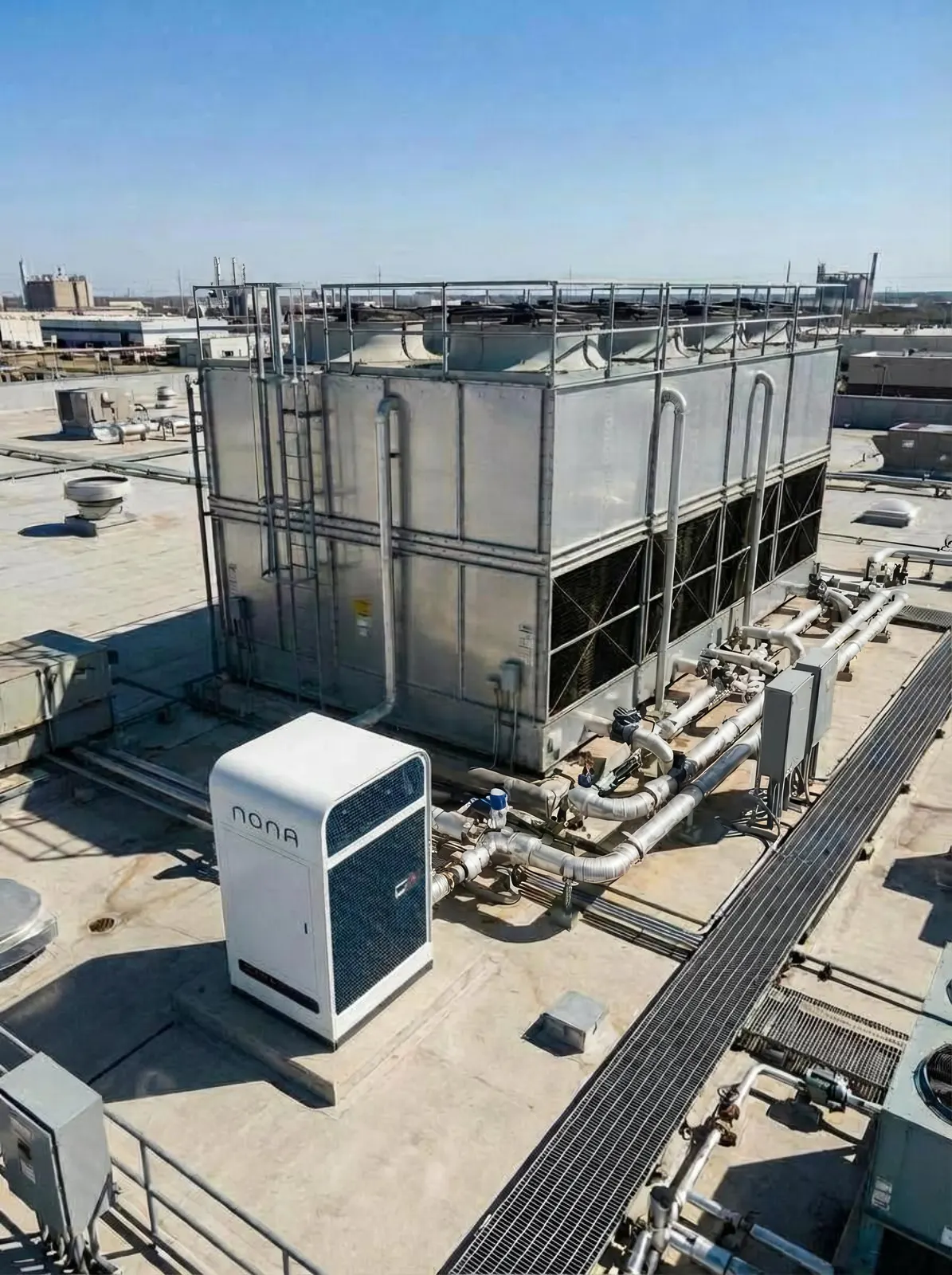
NONA RECOVER targets blowdown. It uses MIT-patented Ion Concentration Polarization to continuously remove dissolved minerals and recover 90% of cooling tower blowdown on site. It does not recover water already lost through evaporation.
Site-level results depend on cooling load, climate, water chemistry, cycles of concentration, and operating conditions. Cooling process reference: U.S. Department of Energy.
Evaporation
Heat leaves with water vapor.
RECOVER does not recover water already lost to the atmosphere.
Blowdown
Mineral-rich liquid leaves the loop.
RECOVER demineralizes this stream and returns 90% on site.
Recover blowdown. Keep the cooling loop.
Next steps
One water question, different decisions.
Developers and operators
Model makeup demand, blowdown, discharge costs, and potential recovery using the facility's operating assumptions.
Calculate your savingsWater and wastewater utilities
Review the proposed load, source, discharge profile, growth assumptions, and infrastructure implications with the project team.
Talk to our technical teamState and local leaders
Use a consistent project checklist to request transparent assumptions without prescribing one cooling design for every site.
Review the water-use guideCommunity and sustainability stakeholders
Separate direct from indirect use, ask what is consumed versus discharged, and look for measurable site-level commitments.
Understand data center water useSource library
Primary references
Lawrence Berkeley National Laboratory
The water use of data center workloadsLawrence Berkeley National Laboratory
2024 United States Data Center Energy Usage ReportVirginia Joint Legislative Audit and Review Commission
Data Centers in VirginiaU.S. Department of Energy
Cooling Water Efficiency Opportunities for Federal Data Centers
Protect capacity with better project assumptions.
Use your cooling load, water rates, chemistry, and operating assumptions to model how cooling tower blowdown recovery could change makeup demand, discharge, and operating cost at a specific site.