Evaporative cooling is the most water-efficient option.
NONA RECOVER is a cooling water recovery system that lets data centers keep evaporative cooling and stop dumping water. It eliminates 90% of wasted water on site with an MIT-patented alternative to reverse osmosis.
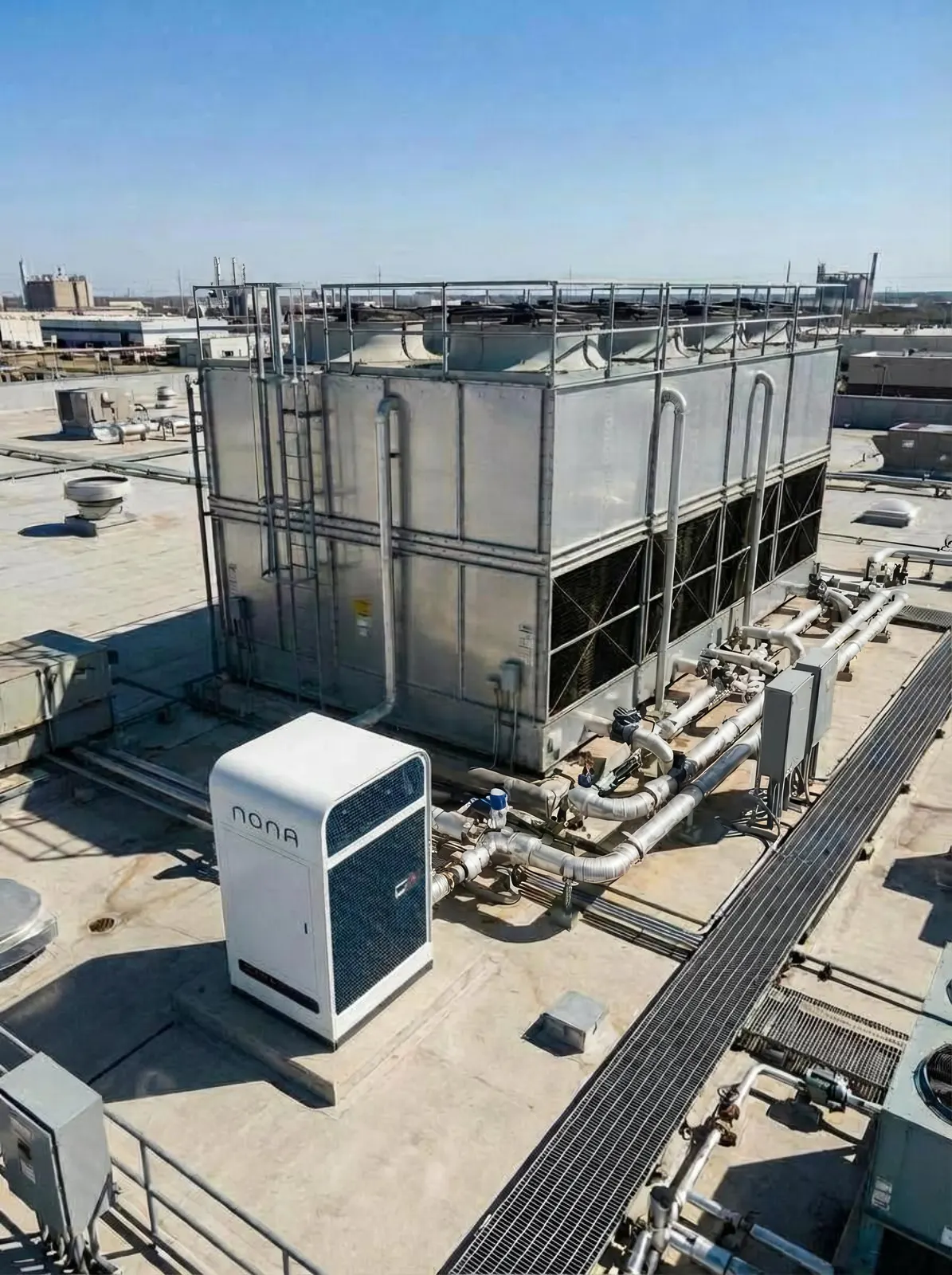
Cooling a data center takes an enormous amount of water.
1,150,000 tons
Water a 50 MW data center's cooling system consumes every year, about 300 million gallons.
Air cooling trades that water for significantly more electricity to reject the same heat. Liquid cooling is where new data centers are heading, but most facilities today still run evaporative towers, and that blowdown is still going down the drain.
How RECOVER works in your cooling towers

- 01
Modular tower retrofit
A skid-mounted unit designed to connect to the cooling tower blowdown line. Tie-in requirements and installation schedule depend on the site.
- 02
Recover liquid blowdown
RECOVER is designed to return 90% of treated cooling tower blowdown to the loop. Evaporation and other site water uses are separate.
- 03
Keep the cooling design
RECOVER treats blowdown alongside a cooling tower. For hybrid sites, wet-mode duty determines how much blowdown is available. Confirm controls and tie-ins with the site team.
Nona RECOVER uses ICP technology.
ICP uses an electric field and ion-selective membranes to separate dissolved ions while bulk water moves through a low-pressure flow channel. Unlike reverse osmosis, it does not force bulk water through a filtration membrane. Fit depends on blowdown chemistry, pretreatment, and the required return-water quality.
How does ICP compare?
For cooling tower blowdown, RECOVER is designed to return 90% of the treated liquid stream to the loop. The September 2026 technical sheet specifies a 5–30 PSI operating range; system energy and the practical recovery rate depend on feed conductivity and treatment targets. Compare site chemistry, pretreatment, concentrate handling, and operating cost before selecting ICP or reverse osmosis.
Not a lab concept. Proven where it counts.
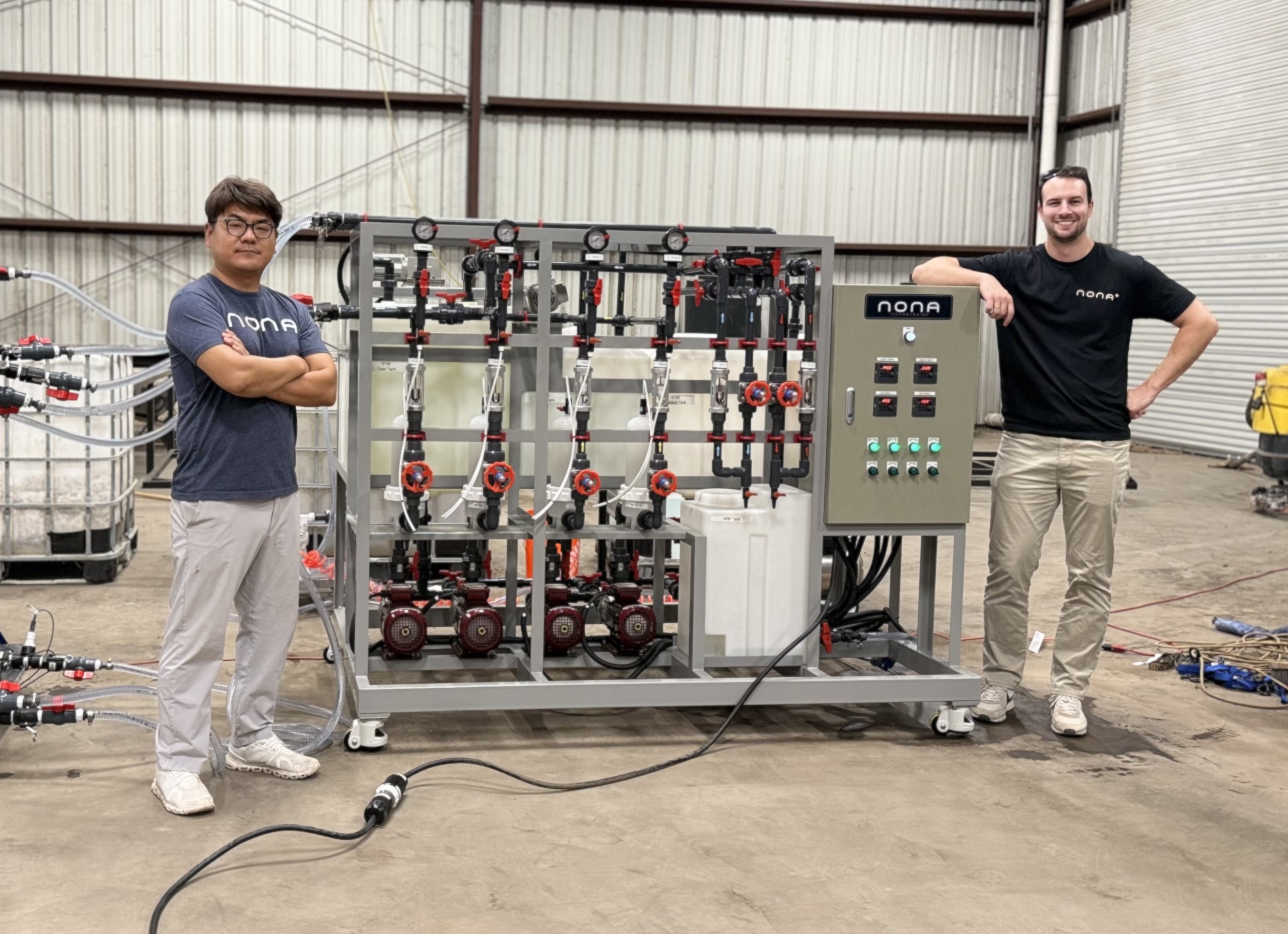
RECOVER isn't a benchtop prototype. It's hardware that has been demonstrated at a renewable power generation site, with recovery rates that are measured, not modeled.
90%
Of wasted water eliminated on site and returned to the cooling loop
Up to 30
Cycles of concentration RECOVER sustains without scaling
< 3 yrs
Typical payback at water-stressed sites
Recovery, cycles-of-concentration, and payback figures validated by a leading air cooling manufacturer. Low-pressure, room-temperature ICP operation confirmed in in-lab testing.

MIT-patented ICP
ICP, Ion Concentration Polarization, was invented and patented at MIT, then engineered into deployable recovery hardware by the Nona team.

Backed by the U.S. Army
The U.S. Army funded the development of ICP for field water production, where reliability and low maintenance are non-negotiable.

Renewable power generation
An industrial RECOVER unit was demonstrated on a working cooling system.
Match the system to the water stream
Cooling tower blowdown
RO brine treatment
Water polishing
Start with your cooling tower size.
RECOVER is designed for operating evaporative cooling towers, including the wet side of a hybrid system when it uses a tower. Enter one scale input for a first estimate, then confirm wet-mode duty, measured blowdown, and chemistry in a technical review.
Your Cooling Tower
Assumes 60% annual operation duty (approx. 5,256 hrs/yr).
WithRECOVER
Potential blowdown returned
13,924kgal/yr
Water and sewer charges avoided
$278,488/yr
Screening figures only. Charges avoided exclude RECOVER energy, maintenance, and capital costs. Confirm tower flow, chemistry, and wet operating hours before using these as site savings.
Request a review of these assumptions
Our team can ask for measured blowdown and water chemistry before estimating site savings.
What you get with RECOVER
| Comparison criterion | RECOVER | Reverse Osmosis | No Treatment |
|---|---|---|---|
| Treatment target | 90% of treated blowdown returned to the loop, design target | Site and feed specific | Blowdown discharged |
| Separation method | Electric field and ion-selective membranes | Water passes through a filtration membrane | No recovery treatment |
| Pressure | 5–30 PSI operating range in Nona's technical sheet | Depends on feed and system design | No recovery treatment |
| Cooling tower chemistry | Review feed, additives, and return-water target | Review feed, pretreatment, and membrane limits | Manage blowdown and discharge |
| Installation | Modular side-stream retrofit; confirm tie-ins | Site-specific system design | No recovery unit |
Site recovery assessment
Move from product fit to a site-specific review.
Share the project stage and what you know today. Nona's technical team will review fit, identify missing inputs, and recommend the next engineering step.
A screening review is not a final design. Actual results depend on cooling load, water chemistry, operating duty, climate, and local rates.